
What Building AI in 2025 Actually Taught Us
In 2025, AI development moved out of controlled environments and into everyday use at a scale many teams were not fully prepared for. Models that performed well in testing began interacting with real users, real data, and real constraints. That shift exposed lessons that could only be learned through experience.
Context Changed Everything
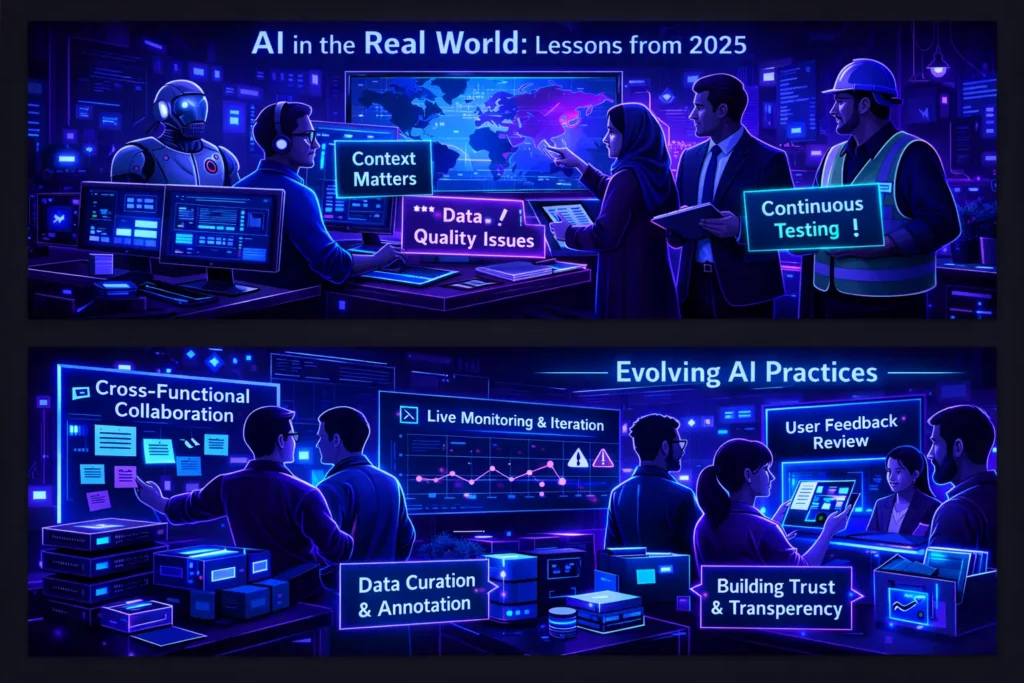
One of the clearest lessons was how sensitive AI systems are to context. A model that performs consistently in one environment can behave very differently when applied across regions, industries, or user groups. Language nuance, cultural expectations, and domain-specific reasoning all influenced outcomes. This pushed teams to pay closer attention to how and where models were being used, not just how they scored in evaluation.
Data Quality Became a Daily Focus
Data quality became a daily concern rather than a setup task. Teams saw how small inconsistencies in labeling or gaps in representation could ripple through a system. Fixing issues at the data level proved more effective than trying to correct behaviour later. As a result, many organisations invested more heavily in data curation, expert review, and clearer annotation standards.
Evaluation Became Continuous
Evaluation practices also matured. Static benchmarks were no longer enough to understand real performance. Teams introduced ongoing testing, scenario-based evaluation, and continuous feedback loops. These practices helped surface issues earlier and gave teams confidence when deploying updates. Evaluation stopped being a gate at the end of development and became part of the entire lifecycle.
Collaboration Became Essential

Another important shift involved collaboration. AI development required closer coordination between engineers, product managers, domain experts, and safety teams. Decisions about model behaviour often needed input from people who understood the real-world implications of outputs. Clear communication and shared understanding proved more valuable than rigid processes.
Deployment Required Ongoing Care
Deployment itself taught teams patience. AI systems needed monitoring, maintenance, and adjustment once they were live. Real-world usage revealed edge cases that were impossible to predict in advance. Teams that planned for iteration and responsiveness adapted more smoothly than those expecting stability from day one.
Trust Had to Be Built and Maintained
Trust also emerged as something that had to be earned repeatedly. Users paid attention to consistency and clarity. When systems behaved unpredictably, confidence dropped quickly. Teams learned that transparency, documentation, and responsiveness mattered just as much as raw capability.
A New Way to Build AI
By the end of 2025, many teams had recalibrated their expectations. Progress came from attention to detail, human judgment, and willingness to revise assumptions. Building AI turned out to be less about breakthrough moments and more about steady refinement.
Conclusion
These lessons now shape how organisations approach the future. AI development is no longer framed as a one-time effort. It is an ongoing process that benefits from care, expertise, and realistic expectations. The teams that absorbed these lessons are better prepared for what comes next.